How should a CFO explain ERP risk to the board?
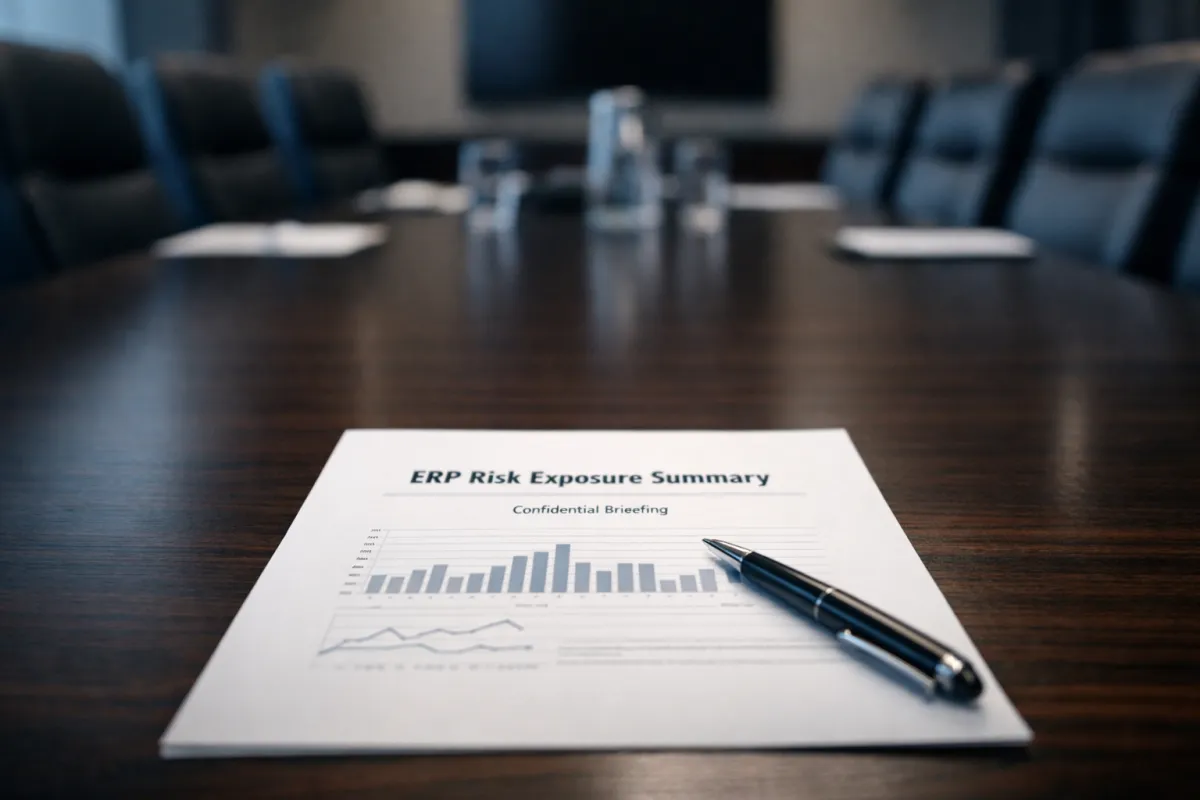
A CFO should explain ERP risk to the board as business exposure that requires governance decisions, not as a technology update that requires patience. ERP exposure is also board exposure, and when operational risk materializes without adequate board visibility, accountability extends beyond management to those responsible for oversight.
Why ERP Belongs on the Board Agenda at All
Most CFOs hesitate to bring ERP to the board. It feels operational. Technical. Something that belongs in steering committees, not boardrooms.
That instinct is wrong, and it is where governance risk begins.
ERP reaches board level the moment it touches any of four domains: financial reporting reliability, compliance exposure, growth readiness, or capital allocation. If the organization’s ERP environment affects how financial results are reported, how regulatory obligations are met, whether the business can scale, or how significant capital is being deployed, the board has a fiduciary obligation to understand the risk. Not the architecture. Not the feature roadmap. The risk.
The threshold test is simple. If ERP instability could cause a qualified financial statement, a delayed filing, a constrained growth initiative, or unplanned capital expenditure, it is a board-level issue. Treating it as anything less creates a governance gap, and governance gaps carry consequences that extend well beyond the organization.
The Exposure Is Not Just Organizational. It Is Personal.
When ERP risk is poorly communicated to the board, the organization is exposed. But so are the directors.
This is not a hypothetical concern. Publicly documented records of corporate scrutiny show a consistent pattern: when boards lack visibility into operational risk and that risk materializes into financial, safety, or compliance failure, accountability reaches the individuals who were responsible for oversight, not just the institution they governed.
The exposure the organization carries and the exposure the board carries are not separate risks. They are the same risk, viewed from different positions. When a CFO frames ERP as a project update, the organization’s exposure remains invisible at the governance level. When that exposure surfaces through audit findings, compliance failures, or financial restatements the board cannot demonstrate that it exercised adequate oversight of a risk it was never asked to govern.
The record does not distinguish between “the board was not told” and “the board did not ask.” In both cases, the governance failure is attributed to the board.
CFOs who keep ERP off the board agenda to avoid complexity are not protecting the board from unnecessary detail. They are increasing its exposure to unmanaged risk.
What the Public Record Shows When Boards Cannot See Risk
The consequences of this dynamic are not theoretical. They are documented, litigated, and widely studied.
Boeing’s 737 MAX crisis revealed through congressional investigation and shareholder lawsuits that the board received updates framed around production targets and delivery schedules, while safety engineering risks remained insufficiently visible at the governance level. When the consequences arrived, scrutiny extended to the board’s oversight responsibilities, not just management’s actions. The lesson is direct. When boards receive progress instead of exposure, they cannot govern what they cannot see.
Theranos demonstrated what happens when boards accept narratives they cannot independently evaluate. Directors with deep credentials outside the technical domain relied on presentations framed in language they could not assess. When the gap between presentation and reality became public, the absence of independent scrutiny became a governance failure attributed to the board itself. For ERP, the parallel is clear. If the board cannot evaluate the risk because the language belongs to another domain, oversight becomes an illusion.
WeWork’s failed IPO exposed a board that had operated on vision-driven narratives rather than exposure-based frameworks. When external scrutiny arrived, the gap between what the board had accepted and what it should have governed became part of the public record. Optimistic narratives did not protect the board from accountability.
The common thread across these cases is framing. The risk was real, but it was not presented in a way that enabled governance. When consequences arrived, the board was present but not informed in a way that allowed it to act.
When Board Communication Works: The Mulally Model
Effective board communication does not require delivering bad news. It requires creating conditions where the board can actually govern.
Alan Mulally’s turnaround of Ford Motor Company provides one of the most studied examples. Mulally instituted a color-coded Business Plan Review where every executive presented their area as green, yellow, or red; with red meaning “I have a problem and I need help.” When the first executive presented a red item, Mulally applauded rather than punished. That single moment transformed the leadership culture from concealment to transparency and gave the board the honest, decision-ready information it needed to govern a massive transformation.
The ERP parallel is straightforward. Boards do not expect perfection. They expect transparency, trade-offs, and clear paths forward. A CFO who presents ERP risk honestly; with exposure quantified, options defined, and decisions clearly requested builds more credibility than one who presents optimistic status updates that later collapse under scrutiny.
Overly optimistic ERP updates erode board trust faster than bad news ever does. And unlike bad news, lost trust does not recover on a timeline the CFO controls.
How Boards Expect Information to Be Presented
Board meetings operate on a consistent culture of decision-ready information regardless of industry or topic. Every item on a board agenda is expected to arrive with a clear structure: here is the situation, here is the exposure, here are the options, here is what we recommend, and here is what we need from you.
ERP presentations routinely violate every one of these expectations. Instead of exposure, the board receives status. Instead of options, it receives a progress report. Instead of a decision request, it receives reassurance. The presentation ends and no director knows what to do with what they just heard because nothing was framed as something they could act on.
This is not a minor formatting issue. When the board cannot govern a risk because it was never presented as one, the organization operates without oversight on one of its most consequential investments. The CFO walks away believing the board is informed. The board walks away believing everything is under control. Neither is true and the publicly available record of what happens when that gap is eventually exposed should inform how every CFO approaches ERP board communication.
What to Include
Every ERP item that reaches the board should be structured around four elements:
Financial exposure — quantified where possible, qualified where not. The board needs to understand what is at risk in terms it already evaluates: reporting reliability, compliance deadlines, unplanned cost, and growth constraints. If ERP instability could affect any of these, the board needs to see it in those terms.
Decision tradeoffs — framed so the board understands what it is choosing between, not just what it is choosing. If the recommendation is to pause a workstream, the board should understand both the cost of pausing and the cost of continuing. If additional investment is recommended, the board should understand what that investment protects and what happens without it. Every exposure item must be paired with a recommended path forward and a clear ask: approve, defer, or escalate.
Timeline risk tied to business milestones — not project milestones. The board does not track sprints or go-live dates. It tracks fiscal quarters, audit windows, compliance deadlines, and growth commitments. ERP risk becomes board-relevant when it threatens something the business has committed to externally.
Governance gaps — where decision-making authority is unclear, where cross-functional accountability is missing, or where the organization lacks the capability to manage the risk it is carrying. These are precisely the kinds of structural issues the board exists to address. Surfacing them is not an admission of failure. It is an exercise of the CFO’s fiduciary responsibility.
What to Leave Out
Equally important is what does not belong in front of the board.
Technical architecture details. Unless a director has deep ERP domain expertise, system architecture discussions consume board time without enabling governance. Translate technical constraints into business impact before they reach the boardroom.
Feature-level progress. The board does not need to know which modules are configured or which integrations are complete. It needs to know whether the system will support reliable financial reporting by the date the organization requires it.
Vendor relationship dynamics. Partner performance issues should be resolved at the management level. They reach the board only when they create material exposure that requires a governance decision; a vendor change, a contract renegotiation, or a material budget impact.
Anything that requires domain expertise to evaluate. If a board member cannot assess the information without ERP-specific knowledge, it has not been translated sufficiently. The burden of translation falls on the CFO, not on the board. This is exactly the failure pattern that Theranos documented at a catastrophic scale, presenting information in a domain the governing body cannot evaluate is not transparency. It is the appearance of transparency without its function.
Why Listing Exposure Alone Is Not Enough
The most common mistake CFOs make in ERP board communication is presenting a list of risks without a decision framework. It feels thorough. It is actually counterproductive.
When the board receives a list of exposures with no accompanying options, trade-offs, or recommendations, one of two things happens. Either the board panics because directors see risk without resolution; or the board disengages because directors see information they cannot act on. Neither outcome serves the organization, and neither protects the board.
Every exposure item presented to the board should answer three questions. What could go wrong and what is the financial consequence? What are the options for addressing it and what does each option cost? And what specific decision is the board being asked to make?
This structure respects the board’s role as a governing body. It gives directors the information they need to exercise judgment. It gives the CFO a defensible record of having surfaced risk with appropriate transparency. And it ensures that the exposure the organization carries is visible, and governable, at the level where accountability ultimately resides.
The Three Questions That Should Structure Every ERP Board Conversation
Beneath all of the structure and formatting, boards evaluating ERP risk are ultimately asking three things:
What could go wrong? Not technically, financially. What reporting breaks? What compliance gaps open? What growth gets blocked? What capital goes unrecovered?
How exposed are we? Not as an organization in the abstract, but specifically: What is the dollar impact? What is the timeline risk? And given what publicly documented records of corporate scrutiny reveal about personal and institutional liability in oversight failures, how exposed is the board itself if this risk is not governed adequately?
What decisions need to be made? Not “what should we know” but “what should we do.” Approve additional investment? Defer a phase? Change governance structure? Escalate a vendor issue? Every ERP board discussion should end with a clear decision point because a board that is informed but not asked to decide is a board that is present but not governing.
Need to explain ERP risk without sounding defensive or vague?
If the next board meeting includes ERP on the agenda, the question is not whether to present the risk. It is how to frame it so the board can govern effectively.
The exposure the organization carries is the exposure the board carries. The publicly available record of corporate oversight failures makes one thing clear: the risk of not presenting ERP exposure honestly is greater than the discomfort of presenting it directly. What the board does not see cannot be governed. What is not governed does not stop being the board’s responsibility.
MVP1st helps CFOs translate ERP complexity into board-ready clarity — structured around the exposure, tradeoffs, and governance decisions that directors expect, in the language they evaluate, with the accountability that fiduciary responsibility demands.
Talk to an MVP1st expert to prepare for your next ERP-related board conversation.
FAQ
Only after translating them into business impact. If a director needs ERP expertise to evaluate the information, it has been framed incorrectly.
Is ERP risk always a board-level issue?
It becomes board-level when it affects reporting reliability, compliance obligations, growth readiness, or capital allocation.
What improves board confidence fastest?
Transparent exposure paired with clear options and explicit decision requests.
Isn’t listing ERP risks enough for the board?
No. Boards govern through decisions, not awareness. Every risk must be paired with an action.