Common Data Cabling Issues and How to Fix Them
Modern businesses rely on fast, stable, and secure network connectivity to operate efficiently. While servers, firewalls, and cloud platforms often get the spotlight, many persistent IT problems stem from a more fundamental source: data cabling.
As a trusted IT Support Company in St. Louis, Essential Network Technologies regularly helps organizations across the region uncover and resolve cabling-related issues that quietly undermine performance, reliability, and growth. Below, we break down the most common data cabling problems we see across industries and explain how a properly designed structured cabling system prevents them.
Why Data Cabling Still Matters
Data cabling is the physical backbone of your network. Every application, device, and connection ultimately depends on clean, well-organized, and standards-compliant cabling. When cabling is poorly installed or outdated, symptoms often appear elsewhere, such as slow networks, dropped connections, or unreliable VoIP calls. These issues are frequently misdiagnosed as software or ISP problems when the root cause lies in the wiring itself.
Common Data Cabling Issues Businesses Face
1. Outdated or Unsupported Cabling
Many facilities still rely on older cabling standards, such as Cat5 or improperly installed Cat5e. These cables were not designed to support modern bandwidth demands, Power over Ethernet (PoE) devices, or high-density wireless networks.
Business impact:
Network bottlenecks and inconsistent speeds
Inability to support VoIP phones, cameras, or Wi-Fi upgrades
Increased troubleshooting time and costs
How structured cabling helps: Upgrading to Cat6, Cat6a, or fiber optic cabling ensures your infrastructure can handle today’s requirements while remaining scalable for future technologies.
2. Poor Cable Management and Labeling
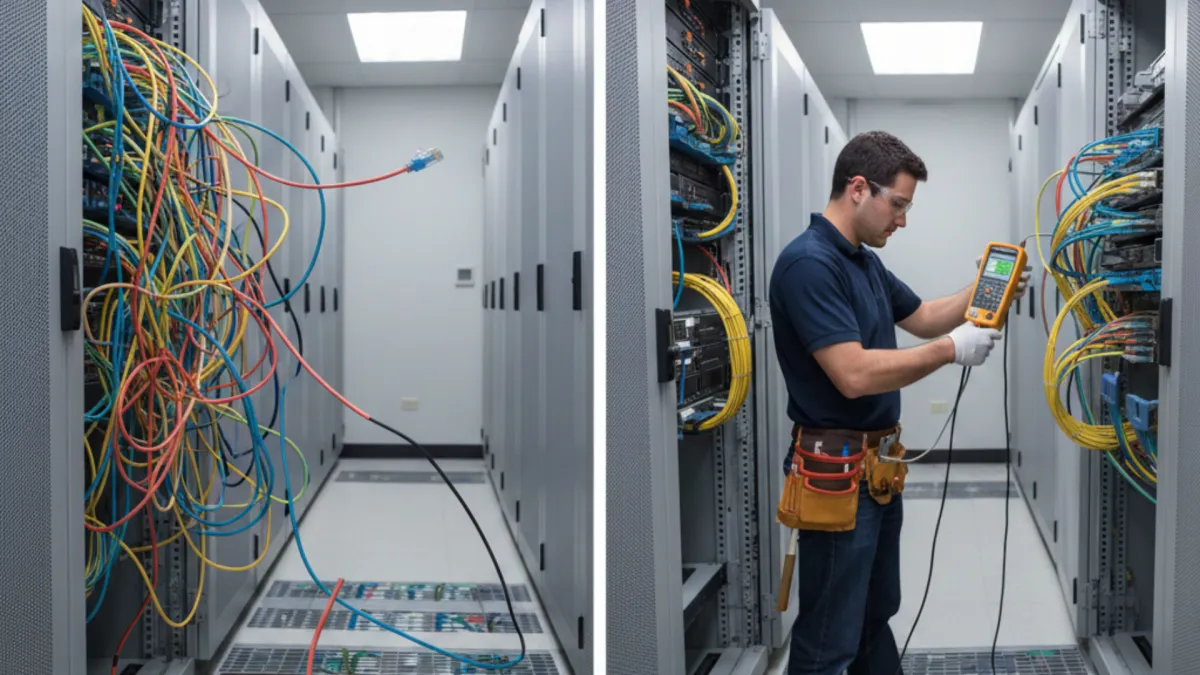
Unlabeled cables, overcrowded racks, and tangled bundles are common in growing environments where cabling was added reactively instead of strategically.
Business impact:
Longer outages during troubleshooting
Increased risk of accidental disconnections
Difficulty onboarding new devices or locations
How structured cabling helps: A professionally designed system includes proper pathways, rack organization, and clear labeling, allowing faster diagnostics and safer changes.
3. Improper Installation Practices
Improper bend radius, excessive cable tension, poorly terminated connectors, and untested runs can all degrade signal quality. These issues may not cause immediate failure but often lead to intermittent problems that are difficult to trace.
Business impact:
Random connectivity drops
Performance degradation over time
Repeated service calls with no clear resolution
How structured cabling helps: Certified installation and testing ensure every cable meets industry standards before it goes into service, reducing long-term risk.
4. Lack of Scalability for Growth
Many businesses outgrow their cabling infrastructure faster than expected. Limited cable capacity, insufficient patch panels, or undersized pathways can make expansion costly and disruptive.
Business impact:
Delays when adding users or equipment
Increased labor costs for retrofits
Greater risk of downtime during expansion
How structured cabling helps: Structured cabling is designed with growth in mind, allowing your network to scale without major rework.
5. Mixing Multiple Vendors and Standards
Over time, some environments become a patchwork of cabling installed by different vendors using different standards and documentation practices.
Business impact:
Inconsistent performance across locations
Limited accountability when problems arise
Difficulty maintaining compliance in regulated industries
How structured cabling helps: Working with a single, experienced provider ensures consistency, documentation, and long-term support.
6. Inadequate Support for Modern Applications
High-definition video conferencing, cloud applications, access control systems, and IoT devices place new demands on network infrastructure.
Business impact:
Lag during video meetings
Dropped calls and poor voice quality
Unreliable security and monitoring systems
How structured cabling helps: Proper cabling design ensures low latency, reliable power delivery, and consistent performance across all systems.
How Essential Network Technologies Addresses These Challenges
At Essential Network Technologies, structured cabling is not treated as a one-size-fits-all service. Our approach is built around understanding how your organization operates today and how it plans to grow.
Customized Assessment and Planning
We begin with a detailed evaluation of your facility layout, user density, traffic requirements, and future goals. This allows us to design a cabling system that aligns with your operational needs rather than simply meeting minimum specifications.
Expert Design and Installation
Our in-house technicians install low-voltage and fiber optic cabling systems engineered for performance, reliability, and scalability. Every installation follows industry best practices and is thoroughly tested to ensure dependable operation.
Ongoing Monitoring and Support
Beyond installation, we remain a long-term partner. Through proactive monitoring, maintenance, and responsive support, we help prevent cabling-related issues before they impact your business.
Industries We Commonly Support
Our structured cabling solutions support a wide range of environments, including:
Corporate offices
Healthcare facilities
Private and public education
Municipal and government entities
Multi-location businesses
Each environment presents unique challenges, and our experience across industries allows us to design solutions that meet both operational and compliance requirements.
When It’s Time to Reevaluate Your Data Cabling Infrastructure
Most businesses don’t realize their cabling is the problem until it starts costing them:
Repeated troubleshooting
Productivity loss
Failed upgrades
Unreliable communications
Disruptions during growth
A properly designed structured cabling system reduces downtime, improves performance, and makes your infrastructure easier to manage for years.
Essential Network Technologies delivers reliable, future-ready cabling solutions for businesses across St. Louis and surrounding communities.
Want to Know If Your Cabling Is Helping You… or Holding You Back?
If your business is dealing with persistent network issues, planning for growth, or upgrading VoIP, Wi-Fi, or security systems, the smartest move is to confirm your cabling foundation is actually ready.
Call Essential Network Technologies at (636) 425-3968 to discuss your environment and find out whether your cabling is supporting your goals or silently limiting your performance
