
Is Your IT Provider Still the Same Company You Signed Up With?
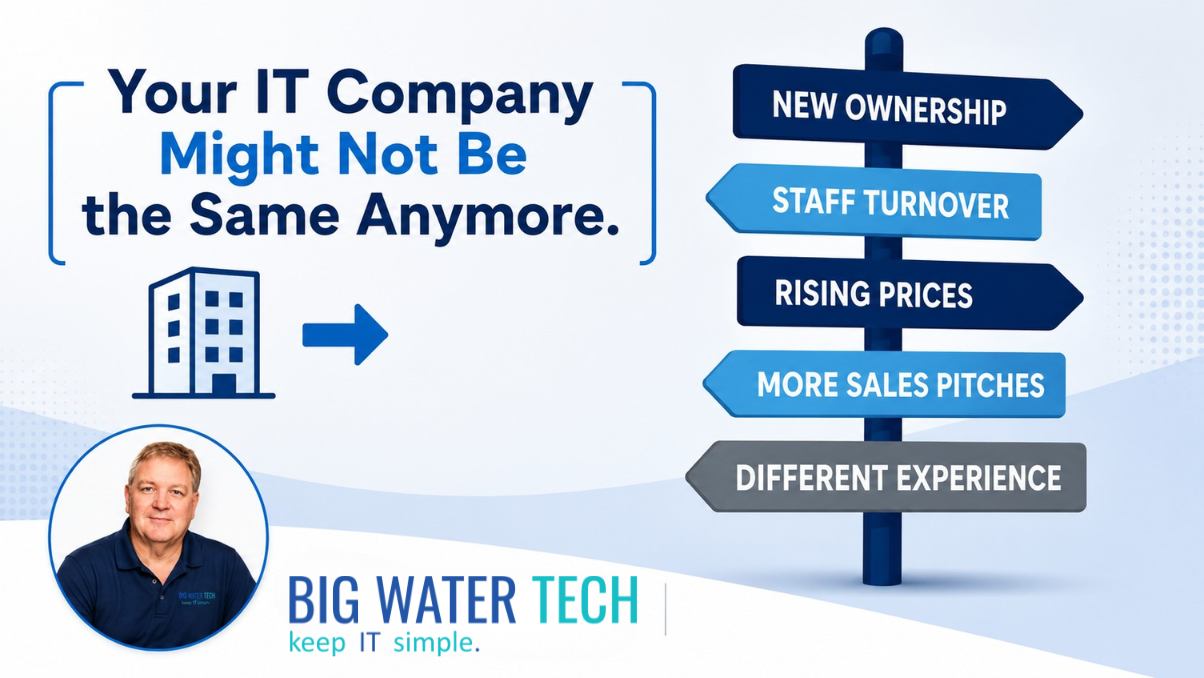
Something feels different. You can't quite put your finger on it. The name on the invoice is the same, the logo hasn't changed, but the relationship doesn't feel like it used to.
The local owner who used to answer the phone? Gone. The tech who knew your systems inside and out? Left six months ago. Prices keep climbing, and every call seems to end with a pitch for something new.
If this sounds familiar, you're not imagining it. Your IT provider may have changed - even if nobody told you.
Why Do IT Companies Get Acquired?
The managed IT industry has been consolidating for years. Smaller local providers get acquired by larger regional companies, and regional players get bought by private equity or investment groups looking to roll up multiple firms under one operation.
Sometimes the change is obvious - the name changes, new branding appears, you get a letter explaining the transition. But often the name stays the same. The acquisition happens quietly. The original owner takes a payout and steps back, the familiar faces start leaving, and over the next year or two, the company you trusted starts operating like a very different business.
This isn't necessarily bad. Some acquisitions bring more resources, better tools, and expanded capabilities. But others bring centralized processes that don't fit smaller clients, aggressive upselling, and a loss of the personal relationship that made the partnership work. The problem is that most clients don't realize what's happened until they're already frustrated.
What Are the Different Types of IT Providers?
Not all IT providers work the same way, and understanding the differences can help you figure out what you're actually buying - and whether it still matches what you need.
The under-5-person shop means you call the owner directly. They probably answer their cell phone on weekends. Service is fast and personal, but capacity is limited - if they get busy or go on vacation, you might wait.
The 6-25 person local company has more resources and broader expertise. They have dedicated roles for support, projects, and account management, but they still know your name, your business, and your quirks. You're not a ticket number.
The 25-100 person regional company runs a centralized help desk with local techs dispatched as needed. More process, more structure, less personal. You might talk to a different person every time you call.
Larger than 100 people? You're a ticket number. Service is standardized and efficiency matters more than relationships. That works for some firms. For others, it's a poor fit.
None of these models are wrong. But you need to know which one you're buying - and whether your provider has quietly shifted from one category to another.
How Do I Know If My IT Provider Has Changed?
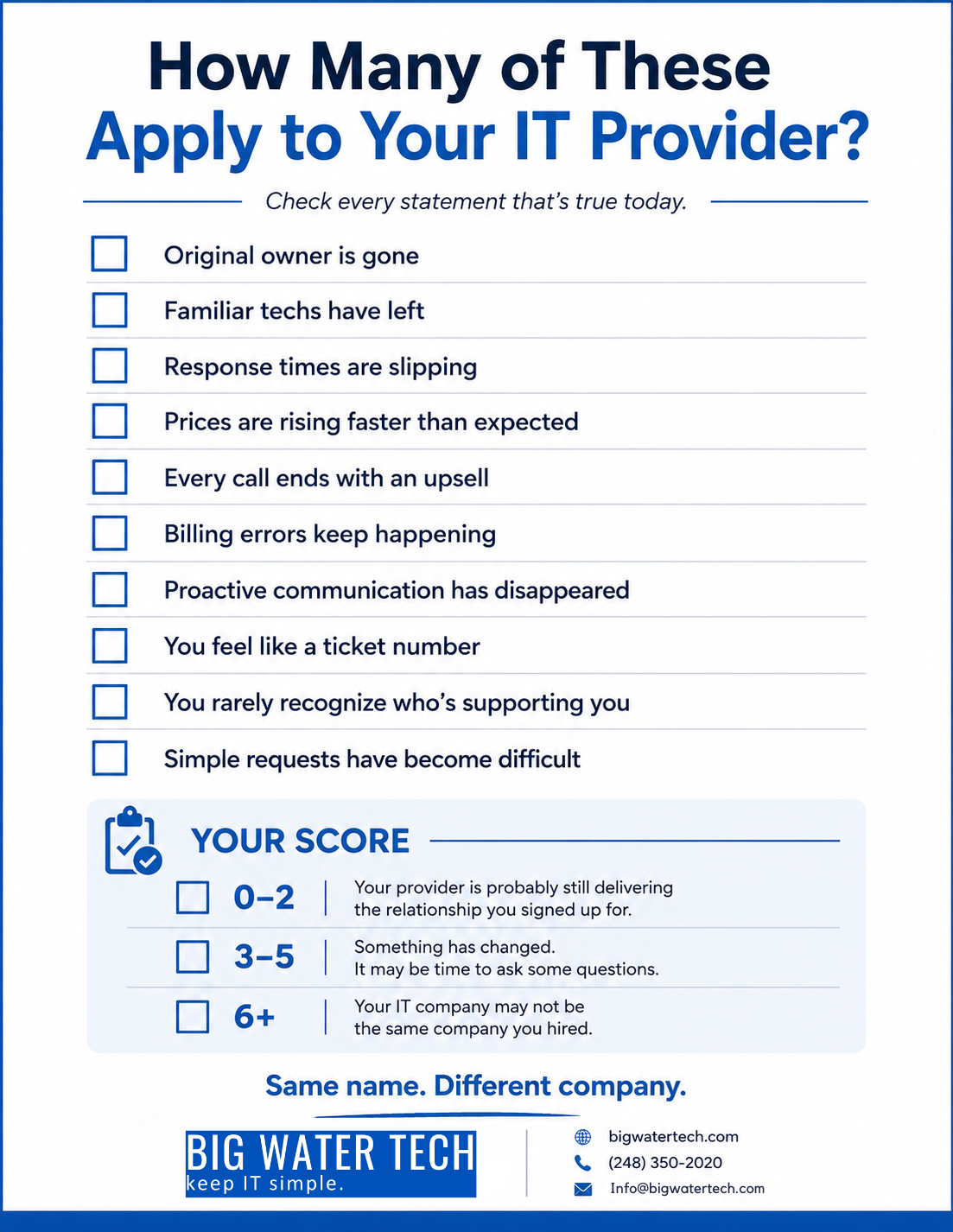
Here are the warning signs that your IT provider isn't the same company you signed up with:
The original owner is gone. You used to call them directly. Now you're not sure who's in charge.
Familiar techs have left. The people who knew your systems, your history, your preferences - they've moved on.
Response times have slipped. What used to be same-day is now "we'll get back to you."
Prices keep climbing. Annual increases that outpace inflation, with vague explanations or none at all.
Every call ends with a pitch. New services, add-ons, upgrades you didn't ask for. It feels more like sales than support.
Billing errors you keep chasing. Line items that don't match, user counts that seem off, credits that take months to appear.
Proactive communication has stopped. You used to hear from them before problems happened. Now you only talk when something breaks.
You feel like a ticket number. Less personal. More process. Less flexibility.
New faces you don't recognize. Every interaction is with someone who doesn't know your environment.
Less flexibility on requests. Things that used to be simple now require approvals, change orders, or extra fees.
None of these alone means you need to switch providers. But if you're checking multiple boxes, it's worth asking whether the relationship still fits what your firm needs. Click this image to get your own checklist copy.
What Happens If My IT Provider Is Dropping the Ball?
Here's what keeps me thinking about this topic: if your provider is slipping on the stuff you can see, what about the stuff you can't?
Billing errors are visible - you notice when the invoice is wrong. But what about backups? Are they actually running? Has anyone tested a restore recently? What about security patches - are your systems current, or are there vulnerabilities sitting unaddressed?
If you're in a regulated industry like accounting, legal, or healthcare, is your provider keeping up with the compliance requirements your insurance carrier or clients expect? These are the things that don't show up until something goes wrong, and by then the damage is done.
If your provider can't get the easy, visible stuff right, it's fair to wonder about the rest.
Should I Switch IT Providers?
If you're seeing warning signs, you have a few options before making any decisions.
Start by having the conversation. Talk to your provider and ask what's changed. Ask who's responsible for your account, ask about response time trends and billing accuracy. A good provider will take the feedback seriously and work to fix it.
Then evaluate what you're actually getting. Look at your last 12 months of invoices and review your support tickets. How long did issues take to resolve? Were the same problems happening repeatedly? Did you feel supported or ignored?
Be clear about what you need. Not every firm needs the same level of service - a 10-person accounting practice has different needs than a 50-person law firm. Know what matters to you, whether that's response time, expertise, personal relationships, or compliance support, and evaluate your provider against that.
If the relationship has changed and conversations haven't fixed it, it might be time to look around. That doesn't mean the grass is greener elsewhere. But it does mean you should know what else is available.
How Do I Evaluate a New IT Provider?
If you decide to explore alternatives, here's what to look for.
Size and structure matter. Does their team size match the level of service you want? Ask how many clients each account manager handles and who you'll actually talk to when you call.
Local presence matters too, especially in Michigan where on-site support can make a difference. If a "local" company only offers remote support, that may not fit your needs. Ask where their technicians are based.
Tenure and stability tell you a lot. Ask how long their team members have been there - high turnover often means the same problems you're trying to escape. Ask for references in your industry, because an IT provider who understands accounting, legal, or healthcare compliance will save you time and headaches.
Get clear pricing with a detailed breakdown. If they can't explain what you're paying for, that's a warning sign. And ask how they communicate with clients - do they reach out before problems happen, or only when something breaks?
The Bottom Line
This isn't about switching providers for the sake of switching. It's about knowing what you're buying and whether it still fits.
The IT industry has changed. Consolidation is real. The local company you signed up with five years ago may not be the same company today, even if the name on the door hasn't changed.
If something feels different, trust that instinct. Ask questions, pay attention to the warning signs, and make sure your IT partner is still the right fit for where your firm is headed.

Ready For A No-Nonsense Approach To IT?
Hire us to set your IT strategy up for sustainable success.
Learn about our proven No-Nonsense approach.
Get an IT roadmap designed specifically for you.
Fearlessly grow your business.
Get in Touch with us!
Call us at (248) 220-7714 or or fill out the form below.
Categories
Featured Posts
Is Your IT Provider Still the Same Company You Signed Up With?
Something feels different. You can't quite put your finger on it. The name on the invoice is the same, the logo hasn't changed, but the relationship doesn't feel like it used to.
The local owner who used to answer the phone? Gone. The tech who knew your systems inside and out? Left six months ago. Prices keep climbing, and every call seems to end with a pitch for something new.
If this sounds familiar, you're not imagining it. Your IT provider may have changed - even if nobody told you.
Why Do IT Companies Get Acquired?
The managed IT industry has been consolidating for years. Smaller local providers get acquired by larger regional companies, and regional players get bought by private equity or investment groups looking to roll up multiple firms under one operation.
Sometimes the change is obvious - the name changes, new branding appears, you get a letter explaining the transition. But often the name stays the same. The acquisition happens quietly. The original owner takes a payout and steps back, the familiar faces start leaving, and over the next year or two, the company you trusted starts operating like a very different business.
This isn't necessarily bad. Some acquisitions bring more resources, better tools, and expanded capabilities. But others bring centralized processes that don't fit smaller clients, aggressive upselling, and a loss of the personal relationship that made the partnership work. The problem is that most clients don't realize what's happened until they're already frustrated.
What Are the Different Types of IT Providers?
Not all IT providers work the same way, and understanding the differences can help you figure out what you're actually buying - and whether it still matches what you need.
The under-5-person shop means you call the owner directly. They probably answer their cell phone on weekends. Service is fast and personal, but capacity is limited - if they get busy or go on vacation, you might wait.
The 6-25 person local company has more resources and broader expertise. They have dedicated roles for support, projects, and account management, but they still know your name, your business, and your quirks. You're not a ticket number.
The 25-100 person regional company runs a centralized help desk with local techs dispatched as needed. More process, more structure, less personal. You might talk to a different person every time you call.
Larger than 100 people? You're a ticket number. Service is standardized and efficiency matters more than relationships. That works for some firms. For others, it's a poor fit.
None of these models are wrong. But you need to know which one you're buying - and whether your provider has quietly shifted from one category to another.
How Do I Know If My IT Provider Has Changed?
Here are the warning signs that your IT provider isn't the same company you signed up with:
The original owner is gone. You used to call them directly. Now you're not sure who's in charge.
Familiar techs have left. The people who knew your systems, your history, your preferences - they've moved on.
Response times have slipped. What used to be same-day is now "we'll get back to you."
Prices keep climbing. Annual increases that outpace inflation, with vague explanations or none at all.
Every call ends with a pitch. New services, add-ons, upgrades you didn't ask for. It feels more like sales than support.
Billing errors you keep chasing. Line items that don't match, user counts that seem off, credits that take months to appear.
Proactive communication has stopped. You used to hear from them before problems happened. Now you only talk when something breaks.
You feel like a ticket number. Less personal. More process. Less flexibility.
New faces you don't recognize. Every interaction is with someone who doesn't know your environment.
Less flexibility on requests. Things that used to be simple now require approvals, change orders, or extra fees.
None of these alone means you need to switch providers. But if you're checking multiple boxes, it's worth asking whether the relationship still fits what your firm needs. Click this image to get your own checklist copy.
What Happens If My IT Provider Is Dropping the Ball?
Here's what keeps me thinking about this topic: if your provider is slipping on the stuff you can see, what about the stuff you can't?
Billing errors are visible - you notice when the invoice is wrong. But what about backups? Are they actually running? Has anyone tested a restore recently? What about security patches - are your systems current, or are there vulnerabilities sitting unaddressed?
If you're in a regulated industry like accounting, legal, or healthcare, is your provider keeping up with the compliance requirements your insurance carrier or clients expect? These are the things that don't show up until something goes wrong, and by then the damage is done.
If your provider can't get the easy, visible stuff right, it's fair to wonder about the rest.
Should I Switch IT Providers?
If you're seeing warning signs, you have a few options before making any decisions.
Start by having the conversation. Talk to your provider and ask what's changed. Ask who's responsible for your account, ask about response time trends and billing accuracy. A good provider will take the feedback seriously and work to fix it.
Then evaluate what you're actually getting. Look at your last 12 months of invoices and review your support tickets. How long did issues take to resolve? Were the same problems happening repeatedly? Did you feel supported or ignored?
Be clear about what you need. Not every firm needs the same level of service - a 10-person accounting practice has different needs than a 50-person law firm. Know what matters to you, whether that's response time, expertise, personal relationships, or compliance support, and evaluate your provider against that.
If the relationship has changed and conversations haven't fixed it, it might be time to look around. That doesn't mean the grass is greener elsewhere. But it does mean you should know what else is available.
How Do I Evaluate a New IT Provider?
If you decide to explore alternatives, here's what to look for.
Size and structure matter. Does their team size match the level of service you want? Ask how many clients each account manager handles and who you'll actually talk to when you call.
Local presence matters too, especially in Michigan where on-site support can make a difference. If a "local" company only offers remote support, that may not fit your needs. Ask where their technicians are based.
Tenure and stability tell you a lot. Ask how long their team members have been there - high turnover often means the same problems you're trying to escape. Ask for references in your industry, because an IT provider who understands accounting, legal, or healthcare compliance will save you time and headaches.
Get clear pricing with a detailed breakdown. If they can't explain what you're paying for, that's a warning sign. And ask how they communicate with clients - do they reach out before problems happen, or only when something breaks?
The Bottom Line
This isn't about switching providers for the sake of switching. It's about knowing what you're buying and whether it still fits.
The IT industry has changed. Consolidation is real. The local company you signed up with five years ago may not be the same company today, even if the name on the door hasn't changed.
If something feels different, trust that instinct. Ask questions, pay attention to the warning signs, and make sure your IT partner is still the right fit for where your firm is headed.
Enroll in Our Email Course

Learn How a No-Nonsense IT Strategy Benefits Your ComBullet listpany:
Strategies to allocate your IT budget efficiently
Enhance cybersecurity defenses on a bButtonudget
Ensure your technology investments continue to serve your business as it grows
Looking to Switch?
© Copyright 2026 Big Water Tech | Privacy Policy | Client Portal | Areas We Serve


