
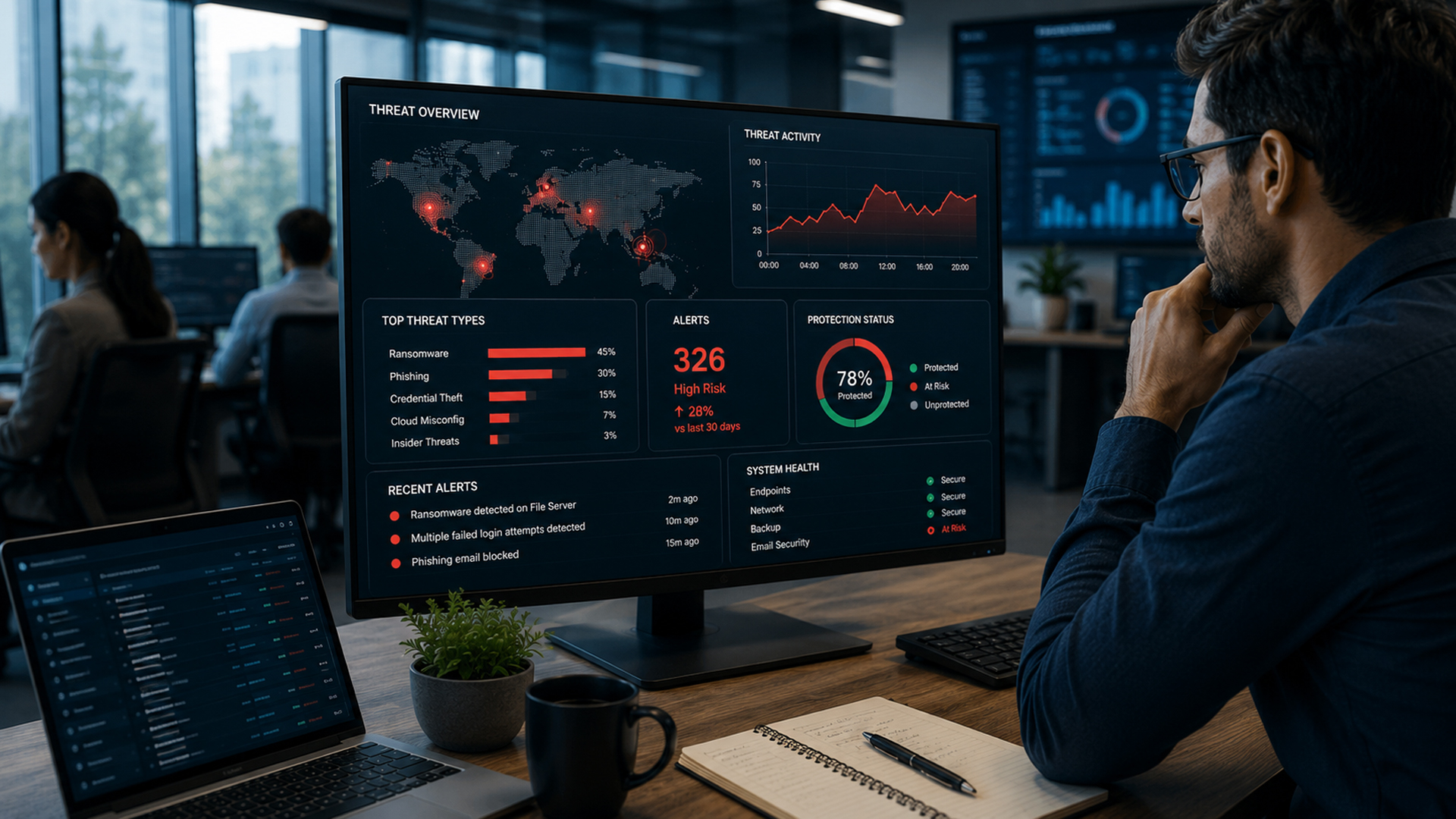
Top Cybersecurity Threats to SMBs in 2026
Cyber threats are no longer random or low-effort attacks.
In 2026, cybercriminals are highly organized and increasingly focused on small and mid-sized businesses.
SMBs are attractive targets because they often lack dedicated security teams and advanced monitoring tools.
A single successful attack can disrupt operations, expose sensitive data, and lead to financial loss.
Many businesses still underestimate how quickly modern attacks can escalate.
Quick Answer: Top Cybersecurity Threats for SMBs
Ransomware attacks that lock business systems
Phishing emails designed to steal credentials
Cloud misconfiguration exposing sensitive data
Insider threats caused by human error or misuse
Credential theft through leaked or reused passwords
Why It Matters in 2026
Cyberattacks have become faster, automated, and harder to detect.
Attackers now use AI to scale phishing campaigns and identify vulnerabilities.
SMBs face increased risk because:
Security tools are often outdated or misconfigured
Employees lack cybersecurity awareness training
Cloud adoption has expanded attack surfaces
Remote work increases entry points for attackers
Even one weak access point can compromise an entire business network.
Major Cybersecurity Threats Targeting SMBs
Ransomware Attacks
Ransomware encrypts business data and demands payment for recovery.
These attacks can shut down entire operations within minutes.
Key risks include:
Permanent data loss if backups fail
High financial ransom demands
Extended downtime affecting revenue
Phishing Attacks
Phishing remains one of the most common entry points for attackers.
Cybercriminals send fake emails that appear legitimate to steal credentials or financial data.
Common tactics:
Fake login pages
Invoice fraud emails
Social engineering messages targeting employees
Credential Theft
Stolen passwords are often sold on the dark web or reused in attacks.
Weak or reused credentials remain a major vulnerability for SMBs.
Impact includes:
Unauthorized access to systems
Email account compromise
Internal data exposure
Cloud Security Misconfigurations
Many SMBs rely on cloud platforms without proper security setup.
Simple configuration errors can expose sensitive data publicly.
Examples include:
Open storage buckets
Weak access permissions
Poor identity management controls
Insider Threats
Not all threats come from outside the organization.
Employees can accidentally or intentionally compromise systems.
Risks include:
Accidental data sharing
Weak password practices
Malicious internal activity
MSP Cybersecurity Protection Strategies
Managed Service Providers help reduce these risks through proactive defense systems.
Key protections include:
Continuous 24/7 threat monitoring
Advanced email filtering for phishing prevention
Endpoint detection and response tools
Cloud security configuration management
Automated backup and recovery systems
Explore cybersecurity services.
Learn more about managed IT services.
Tools, Frameworks, and Best Practices
Modern cybersecurity relies on layered protection strategies.
Key frameworks include:
Zero Trust security model
Multi-factor authentication enforcement
Endpoint Detection and Response systems
Security Information and Event Management tools
Continuous patching and vulnerability management
These tools work together to detect and block threats early.
Cost of Ignoring Cybersecurity Threats
Ignoring cybersecurity risks can result in:
Complete system shutdown due to ransomware
Financial fraud and data theft
Regulatory compliance violations
Loss of customer trust and reputation
High recovery and legal costs
In many cases, recovery costs far exceed prevention investments.
Step-by-Step Protection Framework
Step 1: Risk Assessment
Identify vulnerabilities across systems, users, and networks.
Step 2: Risk Prioritization
Focus on high-impact threats such as ransomware and credential theft.
Step 3: Security Implementation
Deploy monitoring tools, access controls, and endpoint protection.
Step 4: Continuous Monitoring
Track system activity in real time to detect anomalies early.
Step 5: Ongoing Improvement
Update systems, patch vulnerabilities, and refine security policies regularly.
MSP / Cybersecurity Value for SMBs
MSPs provide structured protection without the cost of building internal security teams.
Key benefits include:
Faster response to cyber incidents
Reduced operational risk
Access to enterprise-grade tools
Predictable security costs
Improved compliance readiness
Outsourcing cybersecurity allows SMBs to stay protected while focusing on growth.
Real-World Use Cases
Healthcare
Protects patient records and prevents ransomware attacks.
Finance
Secures transactions and prevents fraud.
Legal
Protects confidential case files and client communications.
SMB Retail
Secures POS systems and payment data.
SaaS Companies
Protects cloud applications and user accounts.
Manufacturing
Secures operational systems and supply chain networks.
FAQ
What is the biggest cybersecurity threat for SMBs?
Ransomware and phishing are currently the most common threats.
Why are SMBs targeted by hackers?
Because they often lack strong cybersecurity defenses.
How do phishing attacks work?
They trick users into sharing sensitive login or financial information.
What is credential theft?
It is when attackers steal or reuse passwords to access systems.
How can SMBs reduce cyber risks?
By using MSP security services, training employees, and enforcing strong access controls.
Are cloud systems safe for SMBs?
Yes, if properly configured and continuously monitored.
Conclusion + CTA
Cyber threats targeting SMBs in 2026 are more advanced and damaging than ever before.
From ransomware to phishing, attackers are constantly evolving their methods.
Businesses that fail to adapt face significant financial and operational risk.
A proactive cybersecurity strategy is essential to stay protected.
👉 Contact CyberStreams today to secure your business with advanced cybersecurity protection and monitoring services.

Ready For A No-Nonsense Approach To IT?
Hire us to set your IT strategy up for sustainable success.
Learn about our proven No-Nonsense approach.
Get an IT roadmap designed specifically for you.
Fearlessly grow your business.
Schedule an Appointment Today
It’s our job to help your business save money, work faster and focus on what is most important. Schedule a 30-minute call to see if we are a good fit to help your organization.
Enter your name and email to get started today.
Featured Posts
Top Cybersecurity Threats to SMBs in 2026
Cyber threats are no longer random or low-effort attacks.
In 2026, cybercriminals are highly organized and increasingly focused on small and mid-sized businesses.
SMBs are attractive targets because they often lack dedicated security teams and advanced monitoring tools.
A single successful attack can disrupt operations, expose sensitive data, and lead to financial loss.
Many businesses still underestimate how quickly modern attacks can escalate.
Quick Answer: Top Cybersecurity Threats for SMBs
Ransomware attacks that lock business systems
Phishing emails designed to steal credentials
Cloud misconfiguration exposing sensitive data
Insider threats caused by human error or misuse
Credential theft through leaked or reused passwords
Why It Matters in 2026
Cyberattacks have become faster, automated, and harder to detect.
Attackers now use AI to scale phishing campaigns and identify vulnerabilities.
SMBs face increased risk because:
Security tools are often outdated or misconfigured
Employees lack cybersecurity awareness training
Cloud adoption has expanded attack surfaces
Remote work increases entry points for attackers
Even one weak access point can compromise an entire business network.
Major Cybersecurity Threats Targeting SMBs
Ransomware Attacks
Ransomware encrypts business data and demands payment for recovery.
These attacks can shut down entire operations within minutes.
Key risks include:
Permanent data loss if backups fail
High financial ransom demands
Extended downtime affecting revenue
Phishing Attacks
Phishing remains one of the most common entry points for attackers.
Cybercriminals send fake emails that appear legitimate to steal credentials or financial data.
Common tactics:
Fake login pages
Invoice fraud emails
Social engineering messages targeting employees
Credential Theft
Stolen passwords are often sold on the dark web or reused in attacks.
Weak or reused credentials remain a major vulnerability for SMBs.
Impact includes:
Unauthorized access to systems
Email account compromise
Internal data exposure
Cloud Security Misconfigurations
Many SMBs rely on cloud platforms without proper security setup.
Simple configuration errors can expose sensitive data publicly.
Examples include:
Open storage buckets
Weak access permissions
Poor identity management controls
Insider Threats
Not all threats come from outside the organization.
Employees can accidentally or intentionally compromise systems.
Risks include:
Accidental data sharing
Weak password practices
Malicious internal activity
MSP Cybersecurity Protection Strategies
Managed Service Providers help reduce these risks through proactive defense systems.
Key protections include:
Continuous 24/7 threat monitoring
Advanced email filtering for phishing prevention
Endpoint detection and response tools
Cloud security configuration management
Automated backup and recovery systems
Explore cybersecurity services.
Learn more about managed IT services.
Tools, Frameworks, and Best Practices
Modern cybersecurity relies on layered protection strategies.
Key frameworks include:
Zero Trust security model
Multi-factor authentication enforcement
Endpoint Detection and Response systems
Security Information and Event Management tools
Continuous patching and vulnerability management
These tools work together to detect and block threats early.
Cost of Ignoring Cybersecurity Threats
Ignoring cybersecurity risks can result in:
Complete system shutdown due to ransomware
Financial fraud and data theft
Regulatory compliance violations
Loss of customer trust and reputation
High recovery and legal costs
In many cases, recovery costs far exceed prevention investments.
Step-by-Step Protection Framework
Step 1: Risk Assessment
Identify vulnerabilities across systems, users, and networks.
Step 2: Risk Prioritization
Focus on high-impact threats such as ransomware and credential theft.
Step 3: Security Implementation
Deploy monitoring tools, access controls, and endpoint protection.
Step 4: Continuous Monitoring
Track system activity in real time to detect anomalies early.
Step 5: Ongoing Improvement
Update systems, patch vulnerabilities, and refine security policies regularly.
MSP / Cybersecurity Value for SMBs
MSPs provide structured protection without the cost of building internal security teams.
Key benefits include:
Faster response to cyber incidents
Reduced operational risk
Access to enterprise-grade tools
Predictable security costs
Improved compliance readiness
Outsourcing cybersecurity allows SMBs to stay protected while focusing on growth.
Real-World Use Cases
Healthcare
Protects patient records and prevents ransomware attacks.
Finance
Secures transactions and prevents fraud.
Legal
Protects confidential case files and client communications.
SMB Retail
Secures POS systems and payment data.
SaaS Companies
Protects cloud applications and user accounts.
Manufacturing
Secures operational systems and supply chain networks.
FAQ
What is the biggest cybersecurity threat for SMBs?
Ransomware and phishing are currently the most common threats.
Why are SMBs targeted by hackers?
Because they often lack strong cybersecurity defenses.
How do phishing attacks work?
They trick users into sharing sensitive login or financial information.
What is credential theft?
It is when attackers steal or reuse passwords to access systems.
How can SMBs reduce cyber risks?
By using MSP security services, training employees, and enforcing strong access controls.
Are cloud systems safe for SMBs?
Yes, if properly configured and continuously monitored.
Conclusion + CTA
Cyber threats targeting SMBs in 2026 are more advanced and damaging than ever before.
From ransomware to phishing, attackers are constantly evolving their methods.
Businesses that fail to adapt face significant financial and operational risk.
A proactive cybersecurity strategy is essential to stay protected.
👉 Contact CyberStreams today to secure your business with advanced cybersecurity protection and monitoring services.
Enroll in Our Email Course

Learn How a No-Nonsense IT Strategy Benefits Your ComBullet listpany:
Strategies to allocate your IT budget efficiently
Enhance cybersecurity defenses on a bButtonudget
Ensure your technology investments continue to serve your business as it grows
Offices
Seattle Office: 951 Industry Drive, Seattle WA 98188
Austin Office: 305 E Huntland Dr. #602, Austin, TX 78752
© Copyright 2026 CyberStreams. Built in partnership with Tech Pro Marketing. | Privacy Policy


